
Women's Gold: The Thousand-Year Story of Shea Butter
Across a 5,000-kilometer band of savanna stretching from Senegal to Ethiopia, the shea tree has sustained communities for at least a millennium, and the women who process its fruit have never stopped innovating.
The Shea Belt
The vitellaria paradoxa tree grows wild across the Sudanian savanna, a zone that spans sixteen countries. It cannot be cultivated in the conventional sense: the trees take fifteen to twenty years to bear fruit, and they thrive only in their native soil. For the communities within this belt, the tree has functioned as a standing pharmacy, a food source, and a trade good simultaneously. Early Arab geographers who crossed the Sahara made note of a pale fat that local people used for cooking and skin care alike.
Women's Cooperatives and the Economics of Craft
Shea processing has historically been women's work, and the knowledge required is considerable. The nuts must be cracked, roasted, ground, kneaded, and churned through a process that can take an entire day. In communities across Burkina Faso, Ghana, and Mali, women's cooperatives have organized this labor for generations, setting quality standards and negotiating with traders. The cooperative model also provided a form of savings and credit long before formal banking reached rural areas.
What Refining Removes
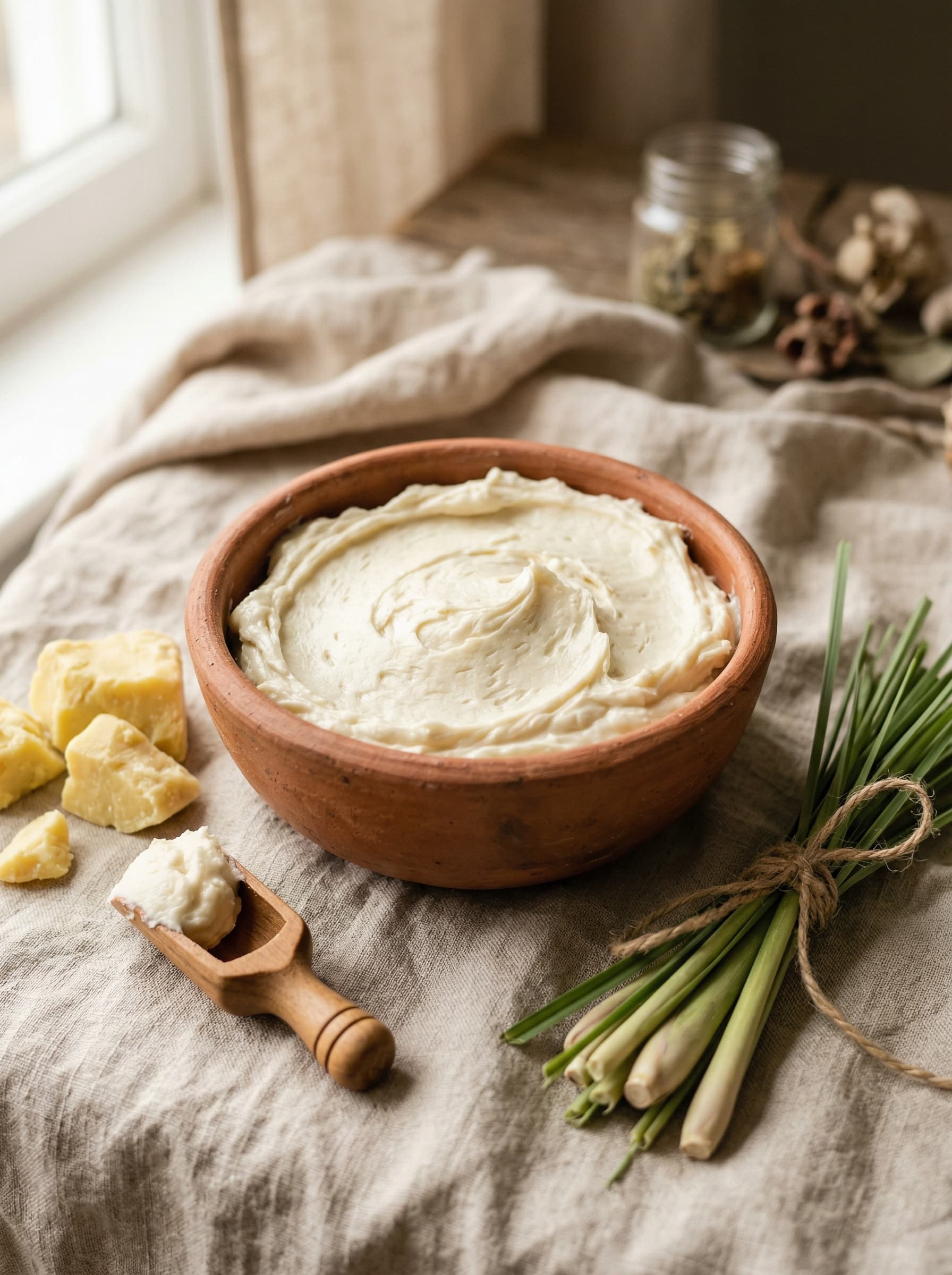
Most shea butter sold in mainstream cosmetic products has been refined, bleached, and deodorized to produce a white, odorless fat with a longer shelf life. This process removes the cinnamic acid esters that give raw shea its natural UV-filtering properties, along with vitamin E, polyphenols, and the earthy scent that identifies it as a living plant product. Unrefined shea, sometimes called raw or natural shea, retains these compounds at the cost of a shorter shelf life and a color that ranges from ivory to pale gold.
What Akente Carries
Akente Express stocks unrefined shea sourced from cooperatives in Ghana and Burkina Faso. The butter is triple-filtered to remove debris without stripping bioactive compounds, and it arrives in reusable glass jars. Staff can advise on uses ranging from deep conditioning to scar management, drawing on formulas that have been in circulation for generations.