
Before Paper Money, There Were Shells: The Global Currency of Africa
African adornment has never been merely decorative. Across centuries and cultures, jewelry, beads, and woven cloth have carried economic value, encoded social information, and served as a medium of diplomacy.
Cowrie Shells from the Maldives
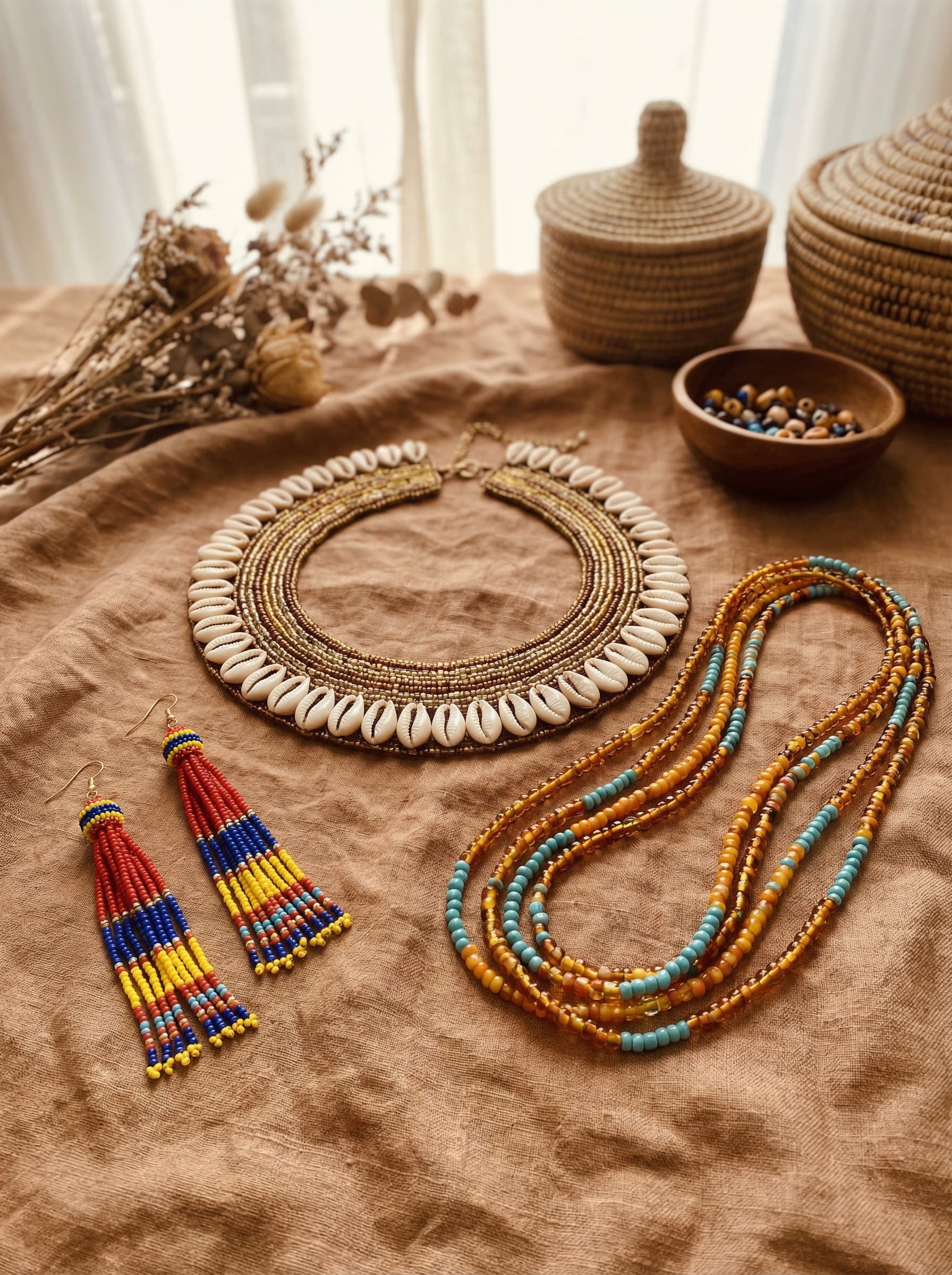
The cypraea moneta cowrie shell, the most widely used currency in West African history, came primarily from the Maldive Islands in the Indian Ocean. Arab and later Portuguese traders brought them to the coast of West Africa beginning in the medieval period, where they entered local economies and became embedded in ritual, trade, and politics. By the 17th century, European slave traders were shipping cowries by the ton from the Maldives to West Africa, using them to purchase enslaved people. The shells that appear in Yoruba religious practice and Akan gold weights carry this layered history in their small, familiar forms.
Maasai Beadwork as Language
Among the Maasai of Kenya and Tanzania, beadwork is not decoration but communication. The color combinations in a necklace or collar convey the wearer's age grade, marital status, and clan affiliation. Young women make beaded gifts for warriors; mothers make collars for sons undergoing initiation. The designs are not arbitrary: specific color sequences have fixed meanings that literate members of the community read as readily as text. Glass beads, which replaced older organic materials after contact with Indian Ocean traders, are now so thoroughly integrated that they function as a traditional medium.
Kente Cloth as Wearable Text
Kente, woven on narrow-band looms in the Ashanti and Ewe regions of Ghana and Togo, is one of the most recognized textiles in the world. What is less widely known is that its patterns function as a writing system. Each design has a name, and each name encodes a proverb, a historical reference, or a philosophical statement. The cloth worn by an Ashanti chief at a state occasion is chosen for what it says, not merely how it looks. Certain patterns are reserved for royalty or specific occasions; wearing the wrong cloth in the wrong context was historically a serious social breach.
What Akente Carries
Akente Express sources jewelry from artisans in Ghana, Nigeria, and Kenya, with an emphasis on pieces made using traditional techniques: lost-wax bronze casting, hand-strung beadwork, and brass work from the Yoruba metalworking tradition. The store also carries a selection of kente accessories, including bags and headbands woven by Ghanaian artisans. Every item in the jewelry section is accompanied by written notes on the technique and region of origin.